Comparisons · September 2026 · 8 min read
Crochet Bag vs. Leather Bag: Which Should You Actually Buy?
You're standing in front of two bags. One is stiff, dark, and smells faintly of tannin. The other is soft, textured, and took someone twenty-odd hours to make by hand. Both cost roughly the same. You can only pick one.
This isn't really a fashion question. It's a materials question wearing a fashion question's clothes. So let's answer it like one.
The quick verdict
**Choose crochet** if you want a bag with visible handwork, you're not caught in monsoon rain often, and you care more about how something was made than how long it'll survive a decade of daily commuting.
**Choose leather** if you need something rigid enough to hold its shape empty, you're regularly out in wet weather, or you want a bag you can hand down.
Side by side
**Structure when empty:** crochet is soft and needs a lining to hold shape; leather is rigid on its own. **Weight:** crochet is lighter; leather is heavier, more so with full-grain. **Water resistance:** yarn absorbs water, which is bad in monsoon; leather is naturally water-resistant, though not waterproof. **Lifespan with care:** crochet lasts years depending on stitch tightness and lining; good leather often 15–20+ years. **Price for handmade quality:** ₹1,000–2,500 for a genuinely hand-crocheted piece; a wide range for genuine full-grain leather. **What breaks each:** machine washing, snagging and UV fading for crochet; cracking from dryness and water staining for leather.
Neither wins outright. That's the honest answer, and it's a better one than the marketing copy on either side would give you.
Durability: how each one actually ages
Leather ages by breaking in. Crochet ages by breaking down, or holding, depending entirely on how it was built.
A crochet bag's durability isn't really about the yarn. It's about three things stacked on top of each other: how tight the stitches are, whether there's a lining, and whether the hardware is reinforced at the stress points. Loose stitches snag. No lining means the bag stretches out of shape within weeks of use, not years. A cotton lining roughly doubles how long the bag holds its shape, because it's the lining carrying the structural load.
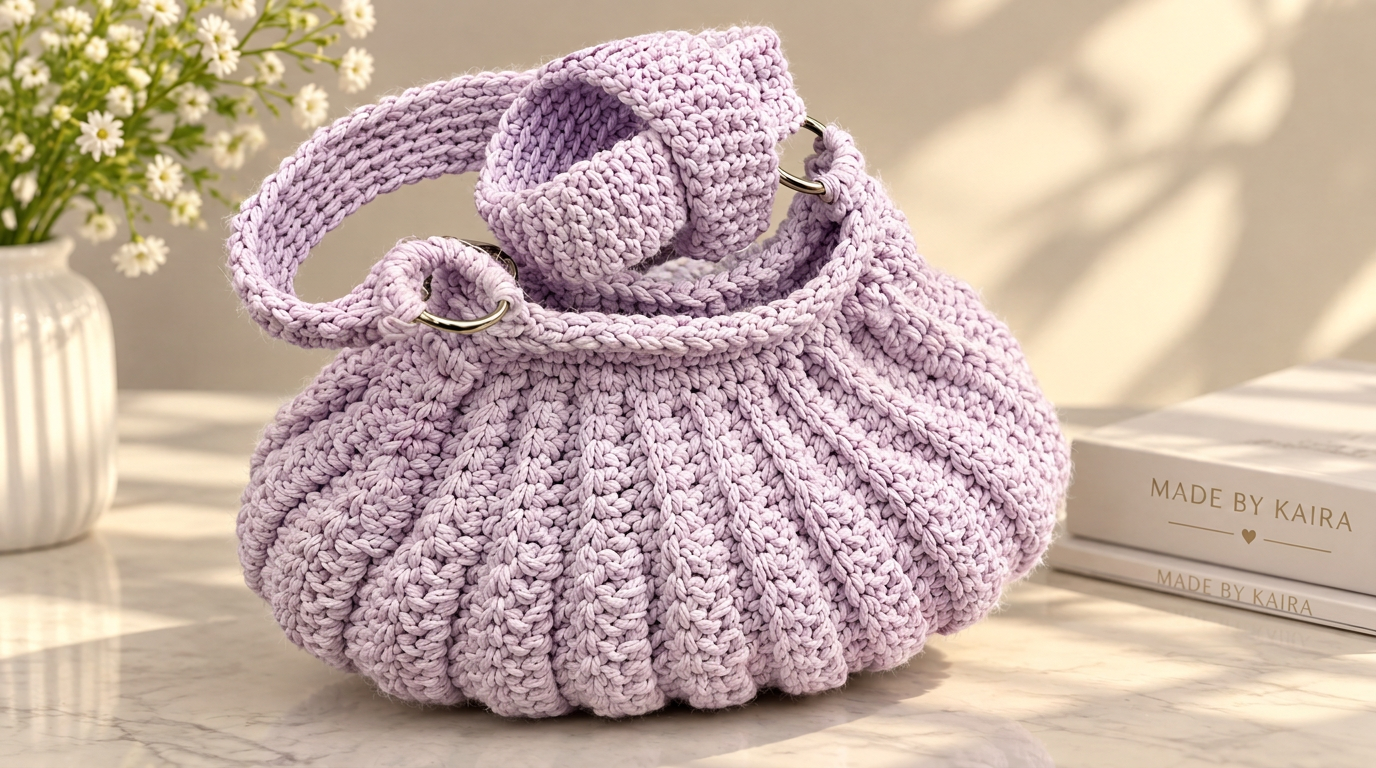
We build every MadebyKaira bag around that fact. The Halo takes 22 to 28 hours specifically because the structured cotton lining and the hand-shaped handle are where most of the labour goes, not the visible bobble stitching everyone notices first. The Cloud, at 16 to 28 hours, is the same story with a different silhouette.
Full-grain leather is durable more or less by default. Twenty years of daily use isn't an unusual claim, and that's not marketing, that's how the material behaves. The tradeoff is that leather's failure mode is different, not absent: it cracks when it dries out, water leaves permanent stains if untreated, and cheap bonded leather can peel within a year. Crochet's durability is a construction question. Leather's durability is a grade question.
Weight: the difference you feel in the first five minutes
A structured leather tote with hardware can sit heavy on your shoulder before you've put a single thing inside it. Crochet starts lighter — acrylic yarn especially, which is what most hand-crocheted bags in India use. Add a phone, a wallet and keys and the difference stays noticeable. If you carry a bag nine hours a day, that difference compounds. If you're an occasional-outing carrier, it barely registers.
Water and weather: leather's real advantage
Here's where we won't pretend. Yarn absorbs water. A crochet bag caught in real rain gets heavy and can take a long time to dry out completely — long enough that whatever's inside it is at risk before the bag itself is.
Leather isn't waterproof either. But it's water-resistant in a way crochet structurally can't be, because the material doesn't wick moisture into open stitch gaps. A quick wipe-down after a light drizzle and a good leather bag is fine. Do that to a soaked crochet bag and you're reshaping wet stitches by hand — see how to clean a crochet bag. If you live somewhere with a real monsoon season, this one fact should weigh more than every other point on this page combined.
Cost: what you're actually paying for
A cheap machine-knit "crochet-style" bag runs ₹300–500. A genuinely hand-crocheted one from a solo maker runs closer to ₹1,000–2,500, and the gap is almost entirely labour, not material. Yarn itself is inexpensive. Eighteen to twenty-eight hours of someone's hands is not.
The Crescent, at ₹1,449, takes 18 to 22 hours. The Pebble clutch, smaller, still takes 16 to 20. None of that time shows up as a line item, but it's the entire reason the price sits where it does. Leather pricing works on a different axis: hide grade, tanning process, hardware quality. Neither is expensive for no reason — they're expensive for different reasons.
Care: what shortens each bag's life
Crochet's enemy is the washing machine. The agitation distorts shaped stitching in ways you can't reverse. Spot-clean with a damp cloth and a mild, dye-free detergent, reshape by hand while damp, and air dry away from direct sun, since UV fades and weakens synthetic yarn over time.
Leather's enemy is dryness, followed closely by neglect. Skip conditioning for a couple of years and the material stiffens, then cracks at the fold lines. A conditioner every few months keeps that at bay — less frequent maintenance than crochet care, but each lapse costs more.
So which one wins?
Neither, and if a comparison page tells you otherwise, it's selling you something.
Buy crochet when you want a bag whose making you can actually picture, and when you're not fighting monsoon rain every other week. Buy leather when you need structure straight out of the box, or a bag you expect to still be using in fifteen years.
We make crochet bags, so you'd be right to expect us to say crochet wins. It doesn't, not universally. It wins for a specific kind of buyer. If that's you, our full guide to buying handmade crochet bags in India covers exactly what to look for — or browse the shop.
Frequently Asked Questions
Are crochet bags as durable as leather bags?
Not in the same way. A well-built crochet bag — tight stitching, cotton lining, reinforced handles — can hold up for years of regular use, but leather's default durability is higher and less dependent on construction quality. Crochet durability is a build-quality question; leather durability is mostly a grade question.
Can I use a crochet bag in the rain?
Not comfortably. Yarn absorbs water and takes a long time to dry, and a soaked crochet bag risks losing its shape. Leather handles light rain far better, though it is water resistant, not waterproof.
Why is a hand-crocheted bag more expensive than a machine-made one that looks similar?
Labour. A genuinely hand-crocheted bag like The Cloud takes 16 to 28 hours of continuous handwork; a machine-knit lookalike takes minutes on a production line. The yarn cost is nearly identical — the price difference is almost entirely the hours.
Does a crochet bag need a lining?
Yes, if you want it to hold its shape. An unlined crochet bag stretches and sags with regular use. A structured cotton lining, used in pieces like The Halo, keeps the silhouette intact over time.
How do I clean a crochet bag without damaging it?
Spot-clean with a damp cloth and a mild, dye-free detergent, reshape it by hand while damp, and air-dry away from direct sunlight. Never machine wash — the agitation distorts hand-shaped stitching in ways you can't undo.
— Kaira