Buying Guide · September 2026 · 9 min read
Handmade Crochet Bags in India: How to Buy One That's Actually Handmade
Type "handmade crochet bag" into any Indian marketplace and you'll get thousands of results in under a second. Some of them took twenty hours to make. Some took twenty minutes on a knitting machine, with the word "handmade" typed into the listing anyway. From a product photo, you usually can't tell which is which.
That's the real problem with buying a crochet bag online in India right now. Not selection — there's plenty of that. Verification. This guide closes that gap: what "handmade" should actually mean, what a real one costs and why, and what to check before you pay for something the listing says it isn't.
The quick checklist
**Ask how long it took.** A genuinely hand-crocheted bag takes somewhere between 15 and 30 hours, depending on size and stitch density. If a seller can't give you a number, that's worth noticing.
**Look closely at the stitches.** Slight variation in tension from one row to the next is normal in hand work. It's a sign of real hands on a real hook, not a flaw. Machine-perfect uniformity is the tell in the other direction.
**Find out who actually made it.** A single maker or a small atelier, not an unnamed factory floor. If nobody can answer "who made this," nobody made it by hand.
**Check what's inside.** Lining that's stitched in by hand holds its shape. Lining that's glued in peels within months.
**Confirm delivery timing.** Real handmade pieces are made to order more often than not. If a "handmade" bag ships the next day from a warehouse, ask why.
**Ask about customization.** Genuine small-batch makers can usually change a colorway on request. Marketplace factories can't. And ask for a real photo of the actual piece, not a catalog shot.
What "handmade" actually means for a crochet bag
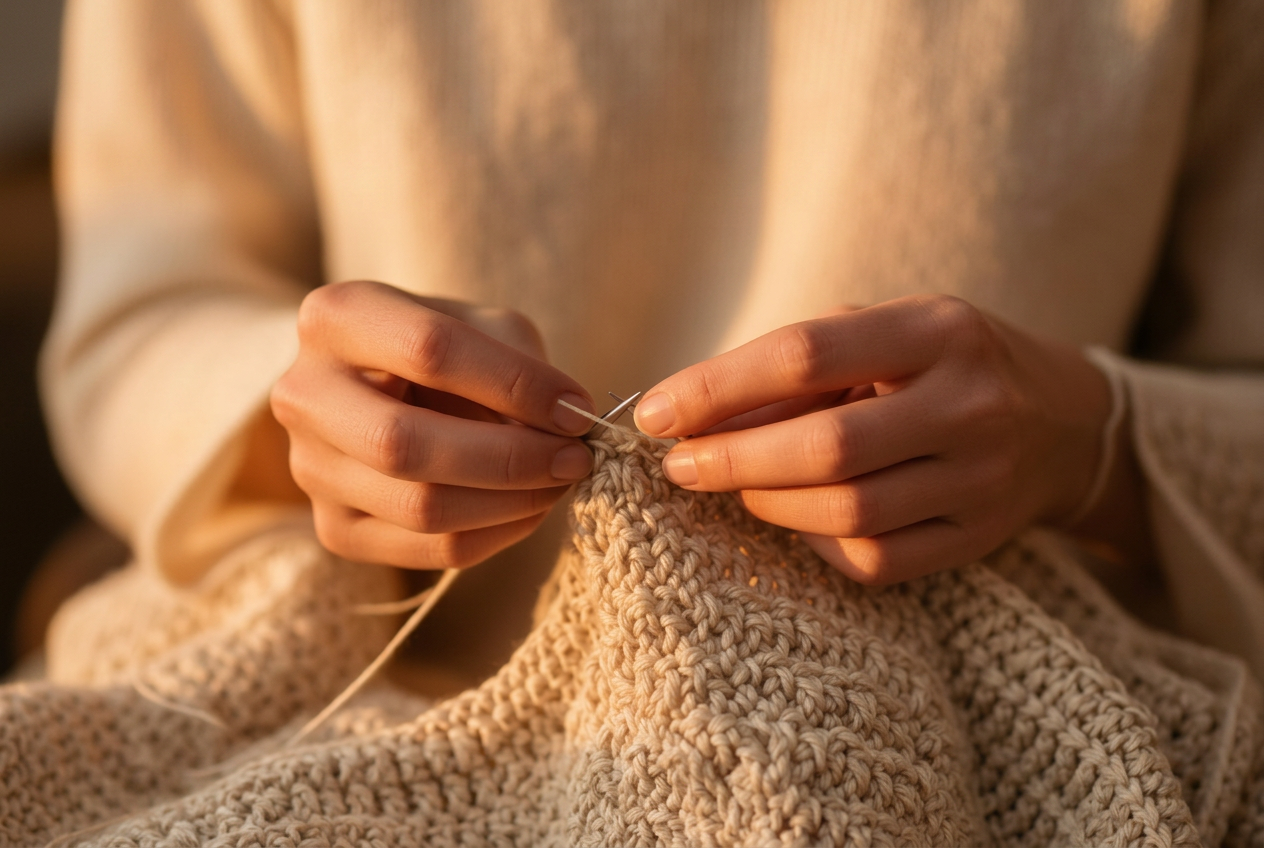
A handmade crochet bag is a bag built entirely with a hook and yarn, one stitch at a time, by a single person, from start to finish. No machine knitting. No pre-made panels stitched together afterward. Every bobble, every row, every curve of the strap is a decision someone made with their hands while they were making it.
A machine can replicate a stitch pattern exactly, the same way every time — which is exactly why it looks different from the real thing up close. Hand tension drifts a little from row to row. Not enough to look sloppy. Just enough to be unmistakably a person's work.
At MadebyKaira, every piece, from a ₹999 Halo to a ₹2,499 Cloud, is worked by one person, start to finish, in Gurgaon. The Cloud specifically took twelve failed attempts before the first one that actually held its shape. That's not a stat you'll find on a factory listing, because a factory doesn't have "attempt thirteen." It has a setting on a machine.
What handmade crochet bags actually cost in India
Here's the honest math. If a maker works 15 hours on a bag and charges even a modest ₹100 an hour for genuinely skilled handwork, that's ₹1,500 in labor before a single rupee of yarn, lining, or hardware goes in. A bag listed for ₹350 didn't have fifteen hours in it. It couldn't have.
**Under ₹800:** almost certainly machine-knit, or assembled from pre-made crochet panels and finished by hand at the seams. Fine for what it is. Just don't pay for "handmade" you're not getting.
**₹800–₹2,000:** a mixed zone. Some genuinely small, hand-crocheted pieces land here, especially smaller accessories — scrunchies, charms, coin pouches rather than full bags. Our own adornments sit at ₹149–₹249 for pieces that take 1–5 hours each, which tracks.
**₹2,000 and up:** where a fully hand-crocheted bag with structured lining and real hardware should sit, once you account for 15–28 hours of continuous handwork plus materials. The Cloud, at ₹2,499 for roughly 16–28 hours, is priced closer to what the labor is actually worth than most of what shows up in a generic search.
None of this is a formal market study. It's labor math, and it's the same math any hand craft category runs on, from pottery to tailoring. The number of hours in a piece is the one thing that doesn't lie, even when the listing does.
Materials that matter: yarn, lining, hardware
**Yarn.** Acrylic is the workhorse for structured bags in India's climate. It holds a shape better than cotton in humidity and doesn't stretch out of form the way natural fiber can over a hot, sweaty commute. Cotton reads softer and breathes better, which is why it shows up more in totes and summer pieces. Jute adds texture but isn't built for daily structural load.
**Lining.** This is the detail almost nobody asks about, and almost every seller skips mentioning. A structured cotton lining, hand-stitched in, is what keeps a crochet bag from stretching into a shapeless bag-shaped object after a month of actual use.
**Hardware.** D-rings, clasps, straps. Silver-tone D-rings and hand-braided cord straps are common on structured shoulder bags. A bag with cheap hardware that rusts, or a strap that's machine-sewn onto a hand-crocheted body, is a hybrid — not a fully handmade piece.
Caring for a handmade crochet bag
Spot-clean, don't submerge — a damp cloth with a little mild soap handles most marks. Let it air dry flat; hanging a wet crochet bag stretches it under its own weight. Store it stuffed loosely with tissue so the shape holds. Keep it away from rough surfaces, because yarn snags. And reshape it by hand periodically after heavy use. The full method is in how to clean a crochet bag.
How durable is a crochet bag, really?
Structurally, a well-made crochet bag with proper lining holds up closer to a canvas tote than to an unlined knit. It's the lining doing the structural work, not the yarn alone. Leather wins on stiffness and water resistance, plainly. Crochet wins on repairability: a loose stitch can be fixed with a hook and ten minutes, where a torn leather seam usually needs a cobbler. If you're weighing the two, read crochet bag vs. leather bag.
The honest answer: a genuinely handmade crochet bag, cared for the way it's meant to be, lasts years — not because the yarn is indestructible, but because it was made by someone who cared whether it held together, and because it can be mended instead of replaced.
Common mistakes when buying a handmade crochet bag in India
Trusting the word "handmade" in a listing title without asking a single follow-up question. Choosing on price alone — the cheapest "handmade" option in a search is very rarely handmade. Assuming crochet bags are fragile and skipping them for occasions where they'd work fine. Not asking about the lining. And ordering a custom color without confirming it before the maker starts, since a made-to-order piece usually can't be returned the way a stocked item can.
Buying online in India: what to check before you order
**Customization and timelines.** Genuine small-batch makers usually take orders through direct conversation as well as a cart, precisely because color and sizing get discussed before anything is made. At MadebyKaira, customization runs through WhatsApp alongside standard checkout — order straight from the shop, or message ahead for a colour outside the standard range.
**Delivery.** A made-to-order piece needs the maker's actual working hours built into the timeline. Fifteen to twenty-eight hours of handwork doesn't compress because a courier is fast. Expect days, not next-day delivery.
**Payment and returns.** Prepaid UPI is standard for most India-based sellers now. Ask specifically about the return policy on customized pieces — it's reasonable for a maker to treat a bag made to your exact colour request as final sale, since it can't be resold as-is.
Ready to look at real ones? Start with The Crescent, The Halo or The Pebble.
Frequently Asked Questions
What are handmade crochet bags?
Handmade crochet bags are bags built entirely by hand with a crochet hook and yarn, one stitch at a time, rather than machine-knit or assembled from pre-made panels. A fully handmade bag typically takes 15–30 hours of continuous work depending on size and stitch density.
How long does it take to make one?
It depends on the piece. A structured handbag runs 15–28 hours; a smaller accessory like a scrunchie or charm takes 1–5 hours. Larger, more densely stitched pieces sit at the higher end of that range.
Are handmade crochet bags durable enough for daily use?
Yes, provided the bag has a structured lining and quality hardware. The lining does most of the structural work — without one, a soft-yarn bag will sag with regular use. With one, a well-made crochet bag holds up for years and can be repaired rather than replaced.
How do I clean a crochet bag?
Spot-clean with a damp cloth and mild soap, air-dry flat away from direct sun, and avoid machine washing or submerging it — both distort the stitch tension.
How do I buy a crochet bag online in India?
Choose a maker who can tell you how long a piece took, what's in the lining, and who actually made it. MadebyKaira takes orders through a standard cart checkout with prepaid UPI, with WhatsApp available for custom colours and sizing.
What should a real handmade crochet bag cost in India?
Under ₹800 is almost certainly machine-knit. ₹800–₹2,000 is a mixed zone that fits smaller hand-crocheted accessories. A fully hand-crocheted, lined bag with real hardware generally starts around ₹2,000 once 15–28 hours of labour and materials are accounted for.
— Kaira